There is an interesting article today in the Press Telegram about Puvunga. The Tongva natives inhabited the area known as Long Beach many years before 1543 when the European Juan Rodriguez Cabrillo "discovered" this special land on the west coast.
The Europeans left the Tongva alone for more than 200 years after Cabrillo's excursion. When the Spanish returned the Tongva were pressed into slavery by the Catholic missionaries. Eventually the Tongva (which translates as "people of the earth") were renamed San Gabriel Mission indians or Gabrielinos after the Mission San Gabriel Arcangel, where they were forced to work the land and tend cattle and sheep.
According to archeologists, the earliest Tongva utilized funeral pyres (ahtochgnah) to cremate their dead. The bones and ashes called kooseerok, were then scattered to the east. Burial sites were called koonsaga. A deeply spiritual people, the Tongva participated in a Tongva mortuary cemetery. Every one to four years, the tribe would hold a "cry" ceremony lasting for 16 days for the people who died since the last cemetery.
Th eastern portion of Long Beach contains a dozen or more archeological sites, including what is believed to be the ancient sacred Tongva village known as Puvunga, also called Pubuna. It is debated whether or not Puvunga is a burial ground even though human remains and artifacts suggesting burial have been found there.
It is clear that the land is considered to be the birth place of the Tongva lawgiver and god Chungichnish.
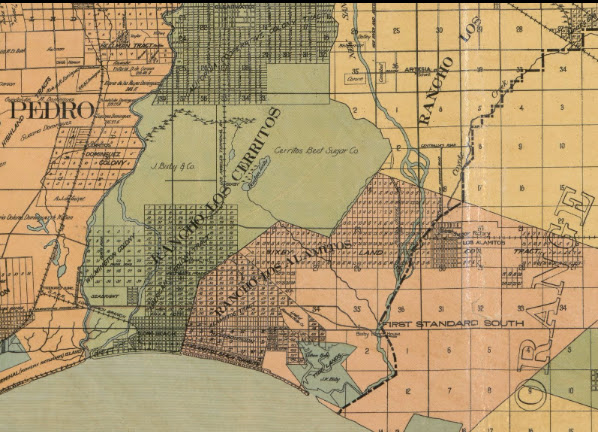
Puvunga is on land of California State University Long Beach and Rancho Los Alamitos historical site, which are adjacent to the now covered Bouton Creek, a tributary of the San Gabriel River that flowed into Alamitos Bay.
Puvunga was listed in 1974 in the National Register of Historic Places. A tribal memorial was placed in Purple Heart Park on the grounds of the VA Medical Center, which is also on Rancho Los Alamitos land.
In 1953, CSULB archaeologist Ethel Ewing removed human remains found underneath the Los Altos shopping center. Bones of 21 individuals and evidence of cremation were stored in the Liberal Arts 5 Bldg. for many years. During a renovation of Los Altos shopping mall in 1996, public art was installed, including the pictured representation of the artifacts found in the soil at Puvunga.
In the 1990s, CSULB officials planned to develop an open field on campus near the Japanese Gardens into a mini mall. The plan was stopped when tribal members and others sued to protect the site. Flyers declaring "Save It, Don't Pave It." and "Go Dig Up Your Own Grandmother!" were used to rally community support. The project was stopped.
While excavating ground to build a new parking structure at CSULB in 1994, more than 1.25 metric tons of shells, bone fragments, bone tools and pottery shards were unearthed, resulting in what archeologists consider to be the best dated find of prehistoric pottery in all of California.
Pages
- Home
- Puvugna
- Puvunga Updates
- History of Signal Hill/ Long Beach Municipal Cemetery
- Municipal Cemetery Updates
- History of Sunnyside Cemetery
- Sunnyside Cemetery Updates
- History of Sunnyside Memorial Park and Mausoleum - Forest Lawn
- Forest Lawn Long Beach Updates
- History of All Souls Cemetery
- All Souls Cemetery Update
- Cemetery Trivia
Search This Blog
Friday, September 23, 2016
Puvunga
Labels:
gerrie schipske,
historic cemeteries of Long Beach,
National Register of Historic Places,
Puvunga,
Rancho Los Alamitos,
Tongva
Monday, September 19, 2016
Monday, September 12, 2016
Wednesday, August 31, 2016
Welcome to Historic Cemeteries of Long Beach
Welcome and thank you for visiting, Historic Cemeteries of Long Beach.
Author and local historian, Gerrie Schipske, is proud to present her fourth book on the early history of her hometown, Long Beach, California.
Gerrie has brought early Long Beach history to life with her stories featured in: "Rosie the Riveter in Long Beach," "Early Long Beach," "Early Aviation in Long Beach," and now "Historic Cemeteries in Long Beach."
Each book chronicles the people and their accomplishments that began and grew "the city by the sea."
This website features the stories of those who are buried in the three historic cemeteries of Long Beach: Municipal Cemetery, Sunnyside Cemetery and Forest Lawn Long Beach. Additionally, Schipske provides a fascinating look at early funeral customs and how they impacted the design of cemeteries. She also discusses
the significance of Long Beach's Civil War veteran population and the areas of the cemeteries in which they are buried.
Historic cemeteries are important to a community because they are outdoor museums where we can discover our past. We get a glimpse of the architecture of earlier times. We can walk around grave sites which are irreplaceable landmarks.
Posts to this site will include updates on each cemetery, events and opportunities to volunteer to help save, protect and preserve our historic cemeteries.
Labels:
all souls cemetery,
civil war,
forest lawn long beach,
GAR,
gerrie schipske,
long beach cemetery association,
municipal cemetery,
signal hill cemetery,
sunnyside cemetery,
sunnyside memorial park and mausoleum
Subscribe to:
Posts (Atom)